
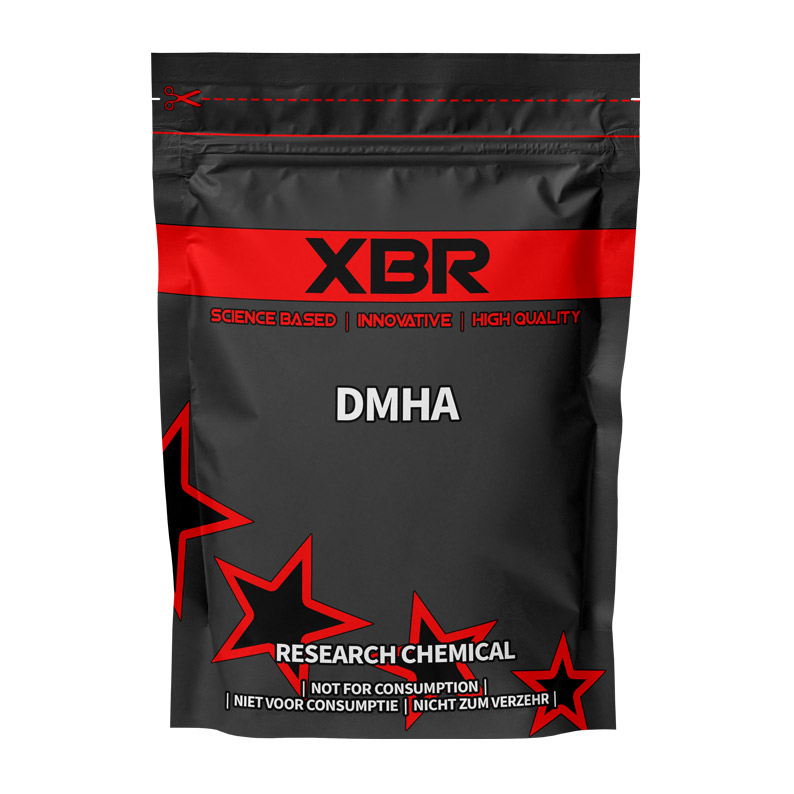
DMHA
Rango de precios: desde €17.50 hasta €49.95
- Nota: No destinado para el consumo
- Solo para fines de investigación
- Similar al DMAA
- Alta calidad y pureza
- Incluye cuchara de 40mg
Descripción
Nota: Este producto no es un suplemento dietético. Este producto es solo para fines de investigación y no está destinado al consumo.
DMHA
DMHA es una sustancia conocida por su posible efecto estimulante. DMHA es muy similar tanto al DMAA como al AMP Citrato. Como resultado, esta sustancia está asociada con una variedad de efectos.
DMHA también puede ser conocido como:
2-Amino-6-metilheptano
2-Amino-5-metilheptano
2-Aminoisoheptano
Octodrina
1,5-Dimetilhexilamina
1,5-DMHA
Información sobre DMHA
Cas: 543-82-8
MF: C8H20ClN
Pureza: ≥ 99%
Funciones de DMHA
DMHA es una sustancia que es principalmente conocida por su efecto estimulante. Debido a su similitud con el DMAA, esta sustancia está asociada con una variedad de efectos [1][2][3][4][5][6][7][8][9][10].
¿De dónde proviene el DMHA?
Este estimulante ocurre en la naturaleza, pero también se produce sintéticamente. En la naturaleza, se encuentra en la corteza del árbol Juglans Regia y en el fruto del árbol Kigelia Africana.
Referencias
- Wang, M., et al. (2018). «1,5-Dimethylhexylamine (octodrine) in sports and weight loss supplements: Natural constituent or synthetic chemical?» Journal of pharmaceutical and biomedical analysis 152: 298-305.
- Catalani, V., et al. (2018). «Octodrine: New Questions and Challenges in Sport Supplements.» Brain sciences 8(2): 34.
- Dreher, M., et al. (2018). «Boost Me: Prevalence and Reasons for the Use of Stimulant Containing Pre Workout Supplements Among Fitness Studio Visitors in Mainz (Germany).» Frontiers in psychology 9: 1134-1134.
- National Museum of American History. Eskay’s Oralator. Retrieved from: https://americanhistory.si.edu/collections/search/object/nmah_737864
- Millan, M. J. (2004). «The role of monoamines in the actions of established and “novel” antidepressant agents: a critical review.» European Journal of Pharmacology 500(1): 371-384.
- Fleckenstein, A. E., et al. (2007). «New Insights into the Mechanism of Action of Amphetamines.» Annual Review of Pharmacology and Toxicology 47(1): 681-698.
- Wise, R. A. and M. A. Bozarth (1985). «Brain mechanisms of drug reward and euphoria.» Psychiatric medicine 3(4): 445-460.
- Hutcheon, D. E. and L. McCullough (1952). «The respiratory stimulant action of octylamines.» British journal of pharmacology and chemotherapy 7(1): 42-46.
- dmaa toxicology report. Retrieved from: https://www.docdroid.net/nfY14Ox/dmaa-toxicology-report.pdf
- Cohen, P. A., et al. (2018). «Four experimental stimulants found in sports and weight loss supplements: 2-amino-6-methylheptane (octodrine), 1,4-dimethylamylamine (1,4-DMAA), 1,3-dimethylamylamine (1,3-DMAA) and 1,3-dimethylbutylamine (1,3-DMBA).» Clinical Toxicology 56(6): 421-426.
Información adicional
| Peso | N/D |
|---|---|
| Ingrediente | DMHA (2-amino-6-metilheptano) 99% |
| Advertencia | Este producto no es un suplemento dietético. Este producto es solo para fines de investigación y no está destinado al consumo. Mantener fuera del alcance de los niños. |
También te recomendamos…
-
Beta ecdisterona 90%
€35.95Seleccionar opciones Este producto tiene múltiples variantes. Las opciones se pueden elegir en la página de producto -
Hordenina
Rango de precios: desde €15.95 hasta €42.95Seleccionar opciones Este producto tiene múltiples variantes. Las opciones se pueden elegir en la página de producto -
Turkesterona
€25.95Seleccionar opciones Este producto tiene múltiples variantes. Las opciones se pueden elegir en la página de producto -
AMP Citrato
Rango de precios: desde €14.95 hasta €44.95Seleccionar opciones Este producto tiene múltiples variantes. Las opciones se pueden elegir en la página de producto
Productos relacionados
-
Creatina monohidratada
€14.95Seleccionar opciones Este producto tiene múltiples variantes. Las opciones se pueden elegir en la página de producto -
Fenibut
Rango de precios: desde €15.95 hasta €23.95Seleccionar opciones Este producto tiene múltiples variantes. Las opciones se pueden elegir en la página de producto -
Polvo de cafeína
€11.95Seleccionar opciones Este producto tiene múltiples variantes. Las opciones se pueden elegir en la página de producto -
5-HTP
Rango de precios: desde €12.95 hasta €33.95Seleccionar opciones Este producto tiene múltiples variantes. Las opciones se pueden elegir en la página de producto
Valoraciones
No hay valoraciones aún.